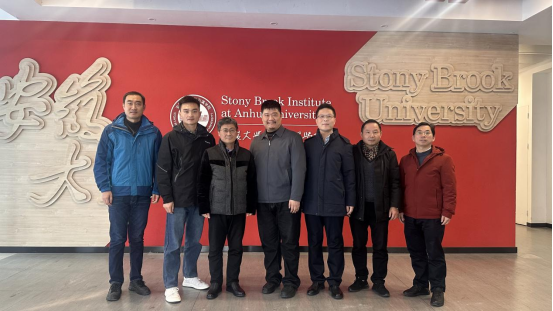
To deepen inter-university collaboration, broaden perspectives on international education work, learn from the advanced experiences of peer institutions, and further enhance the management level of education for international students studying in China, a three-member delegation led by Zhou Yong, Party Secretary of the College, visited the Stony Brook Institute at Anhui University and the International Education College of Anhui University on January 21st and 22nd for exchange and learning.
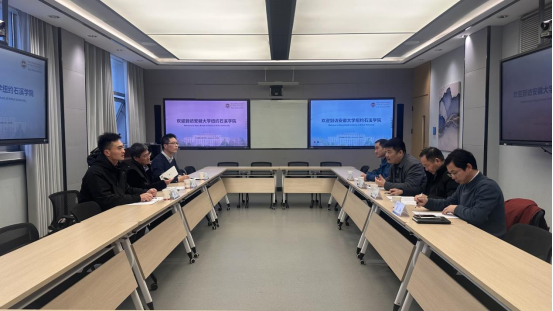
At the Stony Brook Institute at Anhui University, the delegation held a discussion with Institute Dean Huang Zhen and relevant personnel. Dean Huang Zhen extended a warm welcome to the delegation. He pointed out that as Sino-foreign cooperative education institutions, both colleges could exchange insights and learn from each other in areas such as Sino-foreign cooperation models, teaching management, and student management, sharing experiences and seeking common development.
During the discussion, Dean Huang Zhen introduced the talent cultivation positioning, partner institution situation, and training model of the Stony Brook Institute at Anhui University. The Institute, together with its foreign partner university, jointly develops training programs, teaching plans, and assessment standards, establishing a distinctive curriculum system featuring interdisciplinary and professional integration. It imports high-quality foreign educational resources effectively and achieves continuous improvement in education quality through localized integration.
Subsequently, participants from both sides engaged in in-depth discussions on topics of common interest, focusing on issues related to Sino-foreign cooperative education institutions, including departmental structure, foreign partner student registration, language requirements for admission, development of talent cultivation programs, differentiated student cultivation, student enrollment and employment, management of foreign teacher education and teaching, and organization of daily student activities.
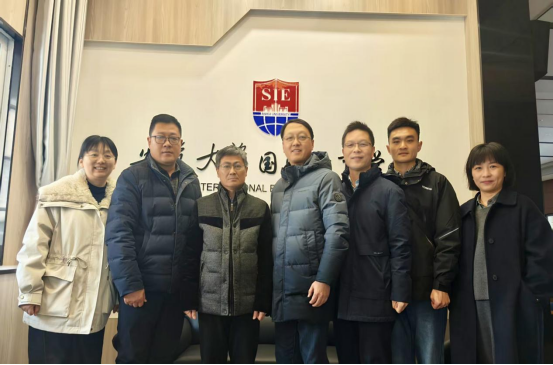
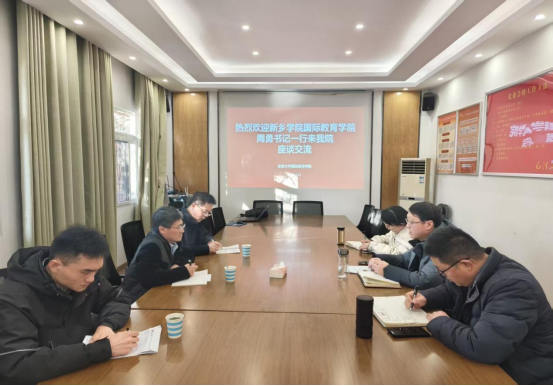
At the International Education College of Anhui University, Associate Dean Zhang Yan provided a detailed introduction to the departmental structure and main responsibilities of the college. In-depth exchanges were held focusing on the key points of teaching management for both degree-seeking and non-degree international students. Dean Zhang shared Anhui University's effective model of integrating Chinese language courses for international students into the university's public course system and coordinating course scheduling with various academic departments, as well as the transition plan from foundational Chinese to specialized Chinese courses. Its national education courses emphasize integrating local cultural characteristics of Anhui Province, providing a vivid medium for international students to perceive China and understand its culture. In terms of non-degree Chinese language teaching, the dual supervision mechanism involving both the college and project centers implemented by Anhui University, along with its model of mentoring new teachers by experienced ones, also offered valuable inspiration for the teaching management of our college.
During the visit, accompanied by relevant personnel from Anhui University, the delegation from the International Education College toured the Stony Brook Institute at Anhui University, the International Education College (Sino-Cambrian College), international student classrooms, and research laboratories, gaining insights into Anhui University's specific practices in guaranteeing conditions for internationalized education.
Through this exchange and learning visit, the distinctive experiences and innovative practices of Anhui University have provided important ideas and multi-dimensional references for our college to promote the operation and management of the Xinxiang University-Melbourne Joint College and optimize the work system for international students studying in China. As a next step, the International Education College will carefully review and summarize the outcomes of this exchange, integrate the advanced concepts and specific practices learned into its daily work based on its actual situation, and continuously broaden the channels for exchange and cooperation with renowned domestic and international institutions, thereby promoting the quality and efficiency of our university's Sino-foreign cooperative education endeavors.